
API integration is like the backstage crew at a rock concert, invisible to the audience but absolutely essential for the show to run smoothly. You don’t think about it when you book a ride, get real-time weather updates, or have your favorite app sync perfectly with your calendar, but trust me, it’s there, making the magic happen.

Key Takeaways

API integration connects different apps so they can share data and work together smoothly.

It helps businesses remove data silos, improve customer experience, and move faster.

Common challenges like legacy systems and security can be solved with the right tools and planning.

There are different types of integrations (data, process, functional, and third-party) for different needs.

Popular Tools: Postman, MuleSoft, Zapier, and Power Automate make integration easier for both developers and non-tech users.
Future Trends: New trends like AI, GraphQL, and event-driven systems are shaping the future of API integration.

What is API Integration?

API integration is the process of creating a means for two or more applications to communicate and share data with each other. Think of APIs (Application Programming Interfaces) as digital messengers that allow different software systems to “talk” to each other in a language they all understand.

When we talk about API integration, meaning in practical terms, it’s essentially building bridges between different software systems, allowing them to work together seamlessly. These bridges enable data to flow automatically between applications without human intervention, creating unified workflows across otherwise separate systems.

Imagine if your e-commerce platform could automatically:

Update inventory levels in your warehouse management system when a sale occurs.

Create a customer record in your CRM when someone makes their first purchase.

Trigger your email marketing platform to send a thank-you message.

Update your accounting software with the transaction details.

All of this happening instantaneously, without manual data entry or transfers, that’s the power of API integrations.

Connect With TechVedi Today to Get Your Software Integrated and Synchronized.

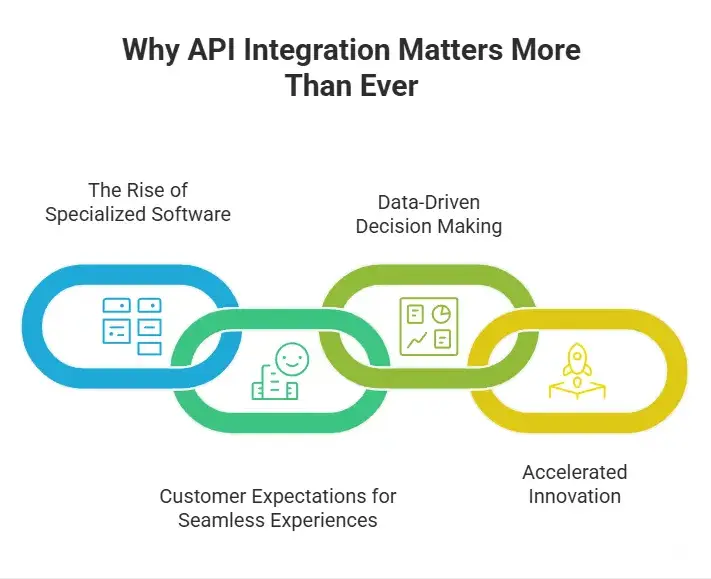
Why API Integration Matters More Than Ever

In our work with clients across industries, we’ve seen firsthand how API integration has evolved from a technical nice-to-have to a business imperative. Here’s why:

1

The Rise of Specialized Software

Today's businesses rely on an average of 110 different SaaS applications. Each application excels at specific functions but creates data silos when not properly connected. API integration breaks down these silos, allowing specialized tools to work as a cohesive system.

2

Customer Expectations for Seamless Experiences

Modern customers expect integrated experiences, they don't care that your inventory system is separate from your order processing software. When they check out online, they expect accurate inventory information and immediate order confirmation. API integration makes these seamless experiences possible.

3

Data-Driven Decision Making

With properly integrated systems and software, data flows freely across your organization, enabling more comprehensive analytics and better-informed decisions. Instead of piecing together reports from multiple sources, integrated systems provide a single source of truth.

4

Accelerated Innovation

When your systems are well-integrated, introducing new features or services becomes significantly easier. Rather than building functionality from scratch, you can leverage existing systems and extend their capabilities through API connections.

Key Benefits of API Integrations You Should Know — Why it Matters More Than Ever. Learn Everything About API Integration with Custom API Experts at TechVerdi.

Want to Create Swiss App?

Types of API Integration: Understanding Your Options

API integrations come in various forms, each suited to different business needs:

01

Data Integration

This most common form of API integration focuses on synchronizing information between systems. For example, ensuring customer data in your CRM matches what's in your support ticket system.

02

Functional Integration

This approach focuses on sharing capabilities between applications. For instance, embedding Google Maps functionality within your food delivery app to calculate delivery times and routes.

03

Process Integration

The most sophisticated form, process integration, creates automated workflows across multiple systems. A customer support ticket might trigger actions across your CRM, knowledge base, billing system, and communication tools.

04

Third-Party Marketplace Integration

Connecting your systems with external platforms like Amazon, eBay, or app stores to expand your reach and capabilities.

Which Option Best Suits You?

If you are confused, we can help you right away. Reach out to our experts.

Common API Integration Challenges (And How to Overcome Them)

While API integration offers tremendous benefits, it’s not without challenges. Here are the most common hurdles we encounter when implementing API integration services:

1. Legacy System Limitations

Many established businesses still rely on older systems that weren't designed with modern API capabilities in mind.

Solution:

API adapters and middleware can bridge the gap between legacy systems and modern applications. In some cases, creating custom APIs for legacy systems is worthwhile for the integration benefits.

2. Security Concerns

Opening communication channels between systems inevitably raises security questions around data access and protection.

Solution:

Implement robust authentication methods (OAuth, API keys), encrypt data in transit, establish clear access controls, and regularly audit system access and activities.

3. Versioning and Maintenance

APIs evolve over time, with new versions potentially breaking existing integrations.

Solution:

Follow API versioning best practices, implement comprehensive testing procedures, and establish monitoring to catch integration failures quickly.

4. Data Format Incompatibilities

Different systems may use different data structures, making direct integration challenging.

Solution:

Implement data transformation services as part of your integration layer to convert information into compatible formats between systems.

Ensure data security and compliance with custom CRM solutions

Popular API Integration Tools and Platforms in 2026

The market for API integration tools has matured significantly, offering options for organizations of all sizes and technical capabilities:

For Developers and Technical Teams

Postman

Postman

Beyond API testing, Postman now offers robust integration capabilities, including automated workflows and monitoring.

MuleSoft

MuleSoft Anypoint Platform

An enterprise-grade solution that combines API management with integration capabilities.

Dell Boomi

Dell Boomi

A unified platform for API management, integration, and master data management.

For Business Users (Low-Code/No-Code)

Zapier

Zapier

Beyond API testing, Postman now offers robust integration capabilities, including automated workflows and monitoring.

Microsoft Power Automate

Microsoft Power Automate

Formerly Flow, this platform enables business users to create automated workflows across Microsoft and third-party applications.

Integromat

Integromat (Make)

Visual integration platform with advanced features but an accessible interface.

For Enterprise Needs

IBM API Connect

IBM API Connect

Comprehensive API lifecycle management with robust security and governance.

Apigee

Apigee (Google Cloud)

Full-featured API management platform with analytics and monetization capabilities.

WSO2

WSO2 API Manager

Open-source API management with extensive customization options.

Choosing the right API integration platform depends on your specific needs, existing infrastructure, technical capabilities, and integration complexity. In our experience, many organizations benefit from a combination of tools for different integration scenarios.

Unlock Growth with TechVerdi’s Solutions

Real-World Examples: API Integration Success Stories

Healthcare Data Integration
Case Study 1

Streamlining Healthcare Data

A healthcare provider struggling with disconnected systems implemented API integrations between their electronic health records, appointment scheduling, and billing systems.

The Result:

A 35% reduction in administrative work, 28% fewer billing errors, and significantly improved patient experiences with faster check-ins.

Omnichannel Retail Integration
Case Study 2

Omnichannel Retail Revolution

A mid-sized retailer implemented API integrations between their in-store POS, e-commerce platform, and inventory systems. This created a true omnichannel experience where inventory updates happened in real-time across all channels.

The Result:

A 22% increase in average order value and 18% improvement in customer retention through cross-channel behavior targeting.

Financial Services Integration
Case Study 3

Financial Services Innovation

A financial services company used API integration to connect their core banking system with fintech partners, allowing them to rapidly roll out new services without rebuilding their entire infrastructure.

The Result:

Introduced innovative lending products and payment methods in months rather than years by opening secure APIs to selected partners.

API Integration Best Practices: Lessons from the Field

Having implemented hundreds of API integrations for clients across industries, we’ve developed a set of best practices that consistently lead to successful outcomes:

01

Begin with a Clear Integration Strategy

Before diving into technical implementation, establish what you're trying to achieve. Document which systems need to connect, what data needs to flow between them, and the business outcomes you expect.

02

Prioritize Security from Day One

Security shouldn't be an afterthought. Implement proper authentication, authorization, data encryption, and regular security audits from the very beginning of the project.

03

Design for Scale and Performance

Consider how your needs will grow. Will the volume of data increase significantly? Design your integration architecture to accommodate future growth and additional systems.

04

Implement Comprehensive Monitoring

Robust monitoring ensures you catch issues before they impact business. Monitor for errors, performance bottlenecks, and unusual patterns that might indicate security concerns.

05

Document Everything

Comprehensive documentation is critical for maintenance. Document API specifications, integration workflows, data mappings, and error handling procedures.

06

Consider an API Gateway

For organizations with multiple APIs, an API gateway provides a single entry point that can handle common functions like authentication, rate limiting, and monitoring.

07

Adopt a Microservices Approach When Appropriate

Breaking down complex integrations into smaller, focused services can make your system more flexible, easier to maintain, and more resilient to failures.

Create Your Customized Software From Our Expert Software Developers

Calculating the ROI of API Integration

Many organizations struggle to quantify the return on investment for API integration initiatives. Here’s a framework we use with our clients:

Direct Benefits

Labor Savings:

Calculate the hours saved by eliminating manual data entry and reconciliation.

Error Reduction:

Estimate the cost of errors (in corrections, customer service, etc.) and the expected reduction.

Increased Transaction Volume:

For customer-facing integrations, calculate the revenue impact of higher conversion rates and faster processing.

Indirect Benefits

Improved Decision Making:

While harder to quantify, better data flows enable more comprehensive analytics and better-informed decisions.

Enhanced Customer Experience:

Estimate the value of higher retention rates and increased customer lifetime value.

Innovation Acceleration:

Consider the competitive advantage of bringing new capabilities to market significantly faster.

For most organizations, the ROI calculation heavily favors investment in API integration, with typical payback periods ranging from 3-18 months depending on complexity and scope.

Need Fast & Reliable Hosting in Switzerland? We’ve Got You Covered!

Getting Started with API Integration: Next Steps

Whether you’re just beginning your API integration journey or looking to expand your existing capabilities, here are practical steps to move forward:

01

Audit Your Current Systems

Identify all the applications your organization uses and map the data flows between them. Look for manual processes that could be automated through integration.

02

Identify High-Value Integration Opportunities

Look for integration points that deliver significant business value, such as customer data synchronization, order-to-cash process automation, and 360-degree customer views.

03

Assess Your Integration Capabilities

Determine if you have the in-house expertise to implement and maintain API integrations, or if you need to partner with integration specialists.

04

Start Small, But Think Big

Begin with a focused integration project that can deliver measurable value quickly, but develop it within a broader, long-term integration strategy.

05

Consider an API-First Approach

For new system acquisitions or development projects, prioritize API capabilities in your requirements to ensure future integration flexibility.

Conclusion: API Integration as a Competitive Advantage

As businesses continue to digitize operations and customer experiences, API integration has evolved from a technical concern to a strategic imperative. Organizations that excel at connecting their systems, data, and processes gain significant advantages:

More efficient operations Better customer experiences Faster innovation More agile business models Richer insights

At TechVerdi, we’ve helped organizations across industries harness the power of API integration to transform their businesses. From streamlining internal operations to creating innovative digital experiences, the right integration approach can unlock tremendous value.

FAQs

SMS API integration is the process of connecting your application/software to an external SMS service, enabling automated sending and receiving of text messages globally. This integration allows your system to communicate with the SMS service through standardized protocols, ensuring seamless message delivery and response handling.

The process of utilizing an API to connect two or more pieces of software is known as API integration.

The four main types of APIs are Open, Partner, Internal, and Composite. It depends completely on your requirements, which suits you better.

Ready to Explore How API Integration Can Transform Your Business?

Contact our integration specialists for a consultation and discover how we can help you connect your systems for maximum business impact.

author-avatar

About SEO Team

Our SEO Team is a powerhouse of digital marketers, content strategists, and search engine optimization experts dedicated to keeping you informed, inspired, and ahead of the curve. From emerging trends in mobile app development and AI solutions to actionable tips on SEO, content marketing, and technical optimization, our team publishes content rooted in data, experience, and innovation. Whether you're a startup founder, digital strategist, or tech-savvy entrepreneur, you’ll find our blogs filled with value-driven insights that help your business thrive in the digital era.